Residential development · Buyer personalization · South Florida
A buyer upgrade strategy that respects the resident and the development.
Residential personalization should not begin with a long list of finishes. For developers, it begins with a disciplined decision framework: which options matter to buyers, which can be delivered reliably and which create a credible commercial opportunity.
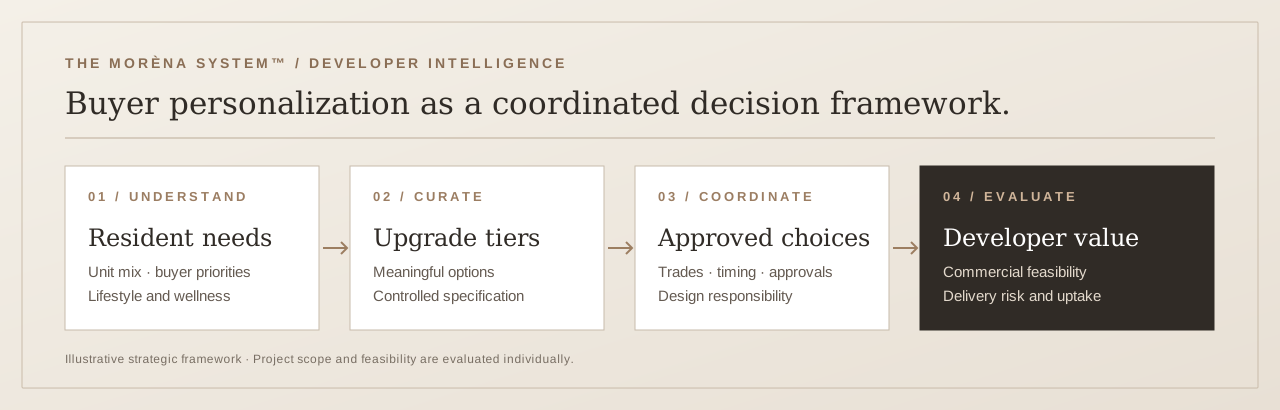
Original MORÈNA design methodology illustration. Implementation scope and project responsibilities are agreed individually.
The hidden cost of unstructured choice
A broad finish menu can look like flexibility, yet introduce duplicated decisions, late substitutions, unclear allowances and avoidable coordination work. Buyers may struggle to understand what changes the way a home lives, while the project team absorbs complexity behind the scenes.
A more useful approach distinguishes a baseline specification from optional upgrades, then connects each selection to the unit type, buyer brief, pricing responsibility and construction schedule. Personalization becomes a managed product decision rather than an open-ended design exercise.
Four decision gates before buyer selections open
The sequence below is an illustrative strategy framework. Specific project capabilities, delivery partners and responsibilities are defined during pilot scoping.
01
Define the buyer and unit mix
Identify the project’s unit types, target buyer segments, decision timelines and the lifestyle priorities that genuinely affect residential choices. A waterfront residence, a pied-à-terre and a family home should not inherit an identical upgrade brief.
02
Build controlled upgrade tiers
Separate base specifications from optional finish, comfort and wellness packages. Document what is included, what is optional and which selections require technical review. Establish a manageable number of meaningful choices rather than an unrestricted catalog.
03
Connect choices to delivery
Map each option to specifications, pricing ownership, procurement lead times, construction dependencies and approval gates. Confirm who signs off on substitutions, drawing revisions and changes after a buyer’s selection deadline.
04
Review the commercial case
Evaluate buyer relevance, potential upgrade margin, administration effort, change-order exposure and delivery risk together. A desirable option is not automatically a profitable or practical offering.
What belongs in an upgrade framework?
Examples include layered lighting and control options, acoustic privacy treatments, material selections evaluated for maintenance and indoor environmental considerations, storage configurations and tailored comfort packages. The right offering depends on the property, applicable codes, project budget and buyer profile.
Illustrative decision matrix, not a priced product catalog
Option category
Buyer value question
Delivery checkpoint
Lighting comfort
Does the option suit routines and visual comfort?
Electrical plan, controls and specification
Acoustic privacy
Where does noise separation matter most?
Assembly feasibility and trade coordination
Material upgrades
Are appearance and maintenance expectations aligned?
Samples, approvals and lead times
Storage and layout
Will the change improve daily function?
Dimensions, scope and construction sequencing
Evaluate revenue potential without overlooking execution risk
Upgrade revenue depends on more than a premium added to a finish. Developers should assess uptake assumptions, supplier and labor costs, design coordination, procurement timing, buyer change requests and the administrative cost of delivering each option. A pilot can establish a transparent baseline and define the measures worth tracking before scale.
THE MORÈNA SYSTEM™ is positioned to connect human-centered design intelligence with structured residential decisions. Any proposed pilot is scoped with the developer; functionality, integrations, commercial terms and delivery responsibilities are confirmed before implementation.
Questions developers ask
When should a developer plan buyer upgrade packages?
Before finish schedules, purchasing commitments and buyer selection deadlines are locked. Early coordination helps the developer assess technical feasibility, lead times, unit variation and decision ownership.
How is a wellness upgrade different from a premium finish?
A premium finish may primarily change appearance. A wellness-oriented option starts with a defined resident need, such as lighting comfort, acoustic privacy or material considerations, and must be assessed for practical suitability rather than marketed as a medical outcome.
Can a pilot start with one unit type?
Yes. A focused pilot may begin with one unit type, a limited set of upgrade packages and agreed review criteria. Scope, integrations and responsibilities are defined with the developer before implementation.
Who remains responsible for construction and permits?
The appointed licensed architects, engineers, contractors and other regulated professionals retain their respective responsibilities. MORÈNA provides human-centered interior design strategy and design coordination within the agreed scope.
Explore a focused pilot for your development.
Share your project location, development stage, approximate unit mix and the buyer upgrade decisions you want to improve. We can discuss a bounded pilot and the relevant design and delivery partners.